

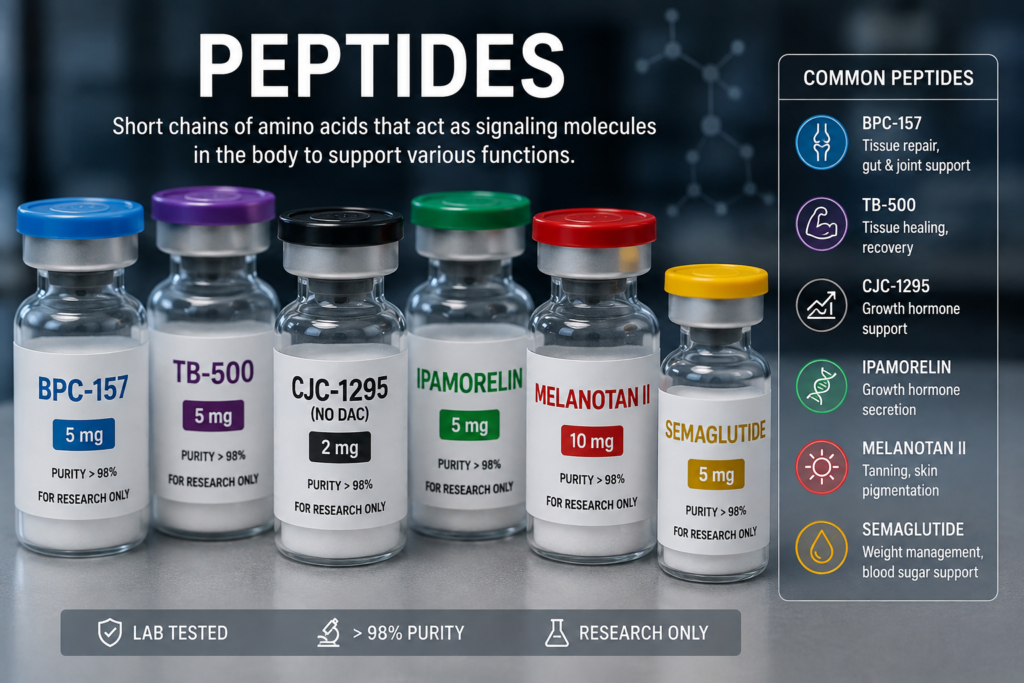
Lyophilized (freeze-dried) peptides arrive as a stable dry powder inside a glass vial. Before research or administration, they must be reconstituted—a process of dissolving the powder into a liquid diluent, typically Bacteriostatic Water (BAC water).
Because peptides are fragile chains of amino acids, following aseptic technique and proper handling is essential to avoid contamination or degrading the compound.
1. What Supplies You Need
Before starting, prepare a clean, sanitized surface with the following items:
-
Lyophilized Peptide Vial: The freeze-dried powder.
-
Diluent: Bacteriostatic Water (0.9% Benzyl Alcohol) is preferred over sterile water because the benzyl alcohol acts as a preservative, preventing bacterial growth for up to 28–30 days after opening.
-
Mixing Syringe: A 1 mL or 3 mL syringe with a 21G to 25G needle for transferring the water.
-
Alcohol Prep Pads: 70% Isopropyl alcohol wipes.
-
Disposal Container: A designated sharps container for used needles.
2. Calculating the Concentration
Understanding the basic math prevents dosing errors:
Example Calculation:
-
Vial contains: $5\text{ mg}$ peptide powder.
-
Diluent added: $2\text{ mL}$ bacteriostatic water.
-
Resulting concentration: $5\text{ mg} \div 2\text{ mL} = 2.5\text{ mg/mL}$.
If you draw $0.1\text{ mL}$ ($10\text{ units}$ on a standard 100-unit U-100 insulin syringe), you will administer:
3. Step-by-Step Reconstitution Process
Clean your table or desk with a disinfectant wipe and thoroughly wash your hands with soap and water.
Pop off the plastic caps from both the peptide vial and the bacteriostatic water vial. Wipe the rubber stoppers of both vials with fresh alcohol prep pads and allow them to air-dry completely (about 15–20 seconds).
Pull back the plunger of your mixing syringe to draw in air equal to the amount of liquid you plan to extract (e.g., $2\text{ mL}$ of air for $2\text{ mL}$ of water).
Equalizing air pressure prevents a vacuum in the water vial, making liquid extraction much easier.
Insert the needle through the center of the rubber stopper into the bacteriostatic water vial. Invert the vial, inject the air, and slowly pull back the plunger to draw the exact required amount of liquid.
Check for large air bubbles and tap the syringe barrel gently to disperse them before withdrawing the needle.
Insert the needle into the rubber stopper of the peptide vial at a slight angle.
Do not spray liquid directly onto the lyophilized powder. Peptides have delicate molecular structures. Instead, slowly press the plunger so the liquid drips gently down the inside glass wall of the vial.
Before pulling the needle out, allow any excess vacuum in the vial to equalize by letting the plunger gently stabilize, or draw out a volume of air equal to the volume of liquid introduced.
Withdraw the needle and discard it into a sharps container.
Gently roll the vial between the palms of your hands or swirl it in smooth circles until the powder fully dissolves into a completely clear liquid. Never shake the vial, as violent agitation can shear and break down the peptide chains.
Storage & Handling Best Practices
| Condition | Guidance |
| Powder (Unreconstituted) | Store unopened powder vials in a freezer ($-20^\circ\text{C}$) or refrigerator ($2\text{–}8^\circ\text{C}$) away from light. |
| Liquid (Reconstituted) | Always store reconstituted peptides in the refrigerator ($2\text{–}8^\circ\text{C}$). Do not re-freeze after mixing. |
| Shelf Life | Once reconstituted with bacteriostatic water, most peptides remain stable for 21–30 days in refrigerated conditions. |
| Visual Check | The solution should be completely clear. If the liquid appears cloudy, discolored, or contains visible floating particles after swirling, do not use it. |