

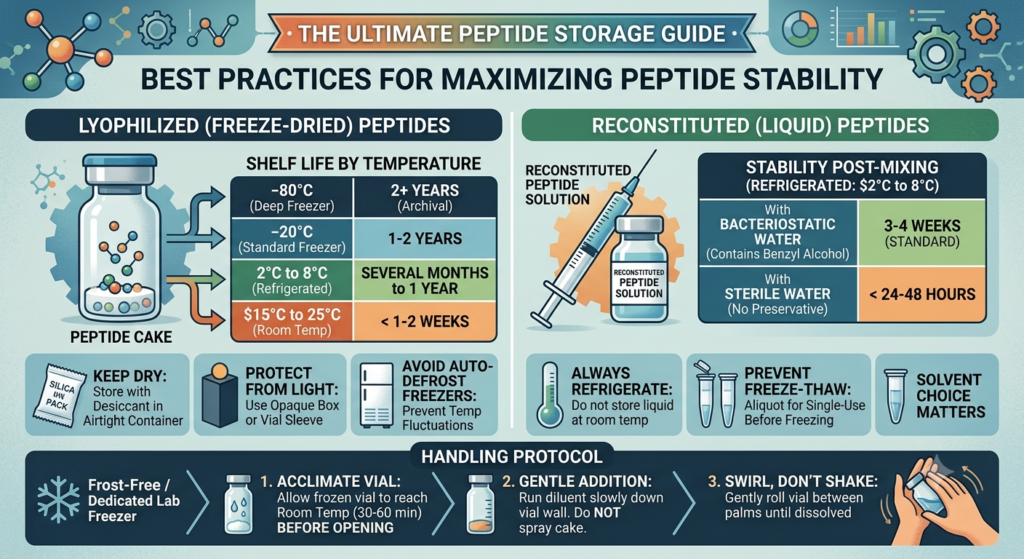
How to store your peptides properly to maintain stability and purity for research use.
Whether conducting laboratory assays or working with research compounds, understanding proper peptide storage and reconstitution protocols is essential. Peptides are fragile chains of amino acids linked by peptide bonds. Improper handling—such as exposure to excessive heat, light, humidity, or aggressive shaking—can cause rapid denaturation, oxidation, and loss of biological activity.
In this guide, we break down everything you need to know about storing lyophilized (powder) and reconstituted (liquid) peptides, temperature thresholds, step-by-step reconstitution, and common storage mistakes.
🎁 SPECIAL RESEARCH OFFER: Save 10% OFF your entire order of research peptides, Bacteriostatic Water, and lab supplies!
Use Coupon Code:
SAVE10(or10OFF) at checkout at PeptideCoding.co.uk
1. Primary Factors That Cause Peptide Degradation
Peptide stability is affected by five key environmental variables:
-
Heat (Thermal Degradation): Elevated temperatures accelerate cleavage of peptide bonds and denature protein structures.
-
Light & UV Rays (Photolysis): Direct light damages sensitive amino acid residues—especially Tryptophan (Trp), Tyrosine (Tyr), Methionine (Met), and Cysteine (Cys).
-
Moisture & Humidity (Hydrolysis): Moisture prematurely hydrates lyophilized powder, triggering hydrolysis before reconstitution.
-
Repeated Freeze-Thaw Cycles: Sharp temperature swings produce microscopic ice crystals that shear peptide molecular bonds.
-
Physical Agitation (Shearing): Vigorous shaking or rough mechanical mixing causes foaming and structural breakdown.
2. Storing Lyophilized (Freeze-Dried Powder) Peptides
When peptides arrive in freeze-dried (lyophilized) powder form, they are in their most stable molecular state.
-
Short-Term Storage (Up to 1 to 2 Months):
Keep lyophilized vials refrigerated between 2°C and 8°C (36°F to 46°F).
-
Long-Term Storage (6 Months to 5+ Years):
Store at -20°C (-4°F) or ideally -80°C (-112°F) in a manual-defrost deep freezer.
⚠️ CRITICAL WARNING — Avoid Auto-Defrost / Frost-Free Freezers:
Standard consumer freezers and frost-free units run automatic heating cycles to prevent ice buildup. These hidden warmth spikes trigger repeated micro freeze-thaw cycles that break down sensitive peptides over time. Always use a manual-defrost laboratory freezer.
3. Storage & Shelf Life Quick Reference Matrix
| Peptide Form | Storage Condition | Target Temperature | Expected Shelf Life | Notes |
| Lyophilized (Powder) | Deep Freezer | -20°C to -80°C |
2 to 5 Years | Long-term standard; use manual defrost |
| Lyophilized (Powder) | Refrigerator | 2°C to 8°C |
1 to 3 Months | Ideal for active research schedules |
| Lyophilized (Powder) | Room Temp | 15°C to 25°C |
1 to 4 Weeks MAX | Avoid high ambient temperatures |
| Reconstituted (BAC Water) | Refrigerator | 2°C to 8°C |
28 to 30 Days | Benzyl alcohol prevents bacterial growth |
| Reconstituted (Sterile Water) | Refrigerator | 2°C to 8°C |
24 to 48 Hours | Single-use only (no preservative) |
4. Step-by-Step Reconstitution Protocol
Follow this sterile reconstitution process to protect peptide purity and structure:
Step 1: Temperature Equalization
Remove the lyophilized peptide vial from the freezer and let it sit at room temperature for 20–30 minutes.
-
Why? Opening or piercing a freezing vial creates immediate condensation inside, adding unwanted moisture to the powder.
Step 2: Sanitize Stoppers
Wipe the rubber stoppers of both the peptide vial and the Bacteriostatic Water vial with a 70% Isopropyl Alcohol swab. Allow them to air-dry completely.
Step 3: Add Diluent Correctly
-
Draw up your measured volume of Bacteriostatic Water (0.9% Benzyl Alcohol) using a sterile syringe.
-
Insert the needle through the stopper at a slight angle.
-
Slowly trickle the liquid down the inner glass wall of the vial.
Never blast the diluent directly onto the powder cake.
Step 4: Gentle Dissolution (No Shaking!)
Gently swirl the vial in a slow, circular motion until all powder dissolves.
-
NEVER SHAKE THE VIAL. Shaking introduces air bubbles, causes heavy foaming, and denatures fragile peptide chains.
5. Storage Rules for Reconstituted (Liquid) Peptides
Once converted to liquid, peptides become significantly more vulnerable to environmental degradation:
-
Always Refrigerate Immediately: Store reconstituted vials at 2°C to 8°C (36°F to 46°F) at all times.
-
Do NOT Re-Freeze Liquid Peptides: Freezing liquid solutions creates large ice crystals that shatter the peptide structures. Once reconstituted, keep it in the fridge—never put liquid back into the freezer.
-
Observe the 30-Day Window: When reconstituted with Bacteriostatic Water, use within 28–30 days.
-
Protect from Light: Store vials inside a dark box or protective vial sleeve away from direct refrigerator bulb exposure.
🛍️ Special Discount Code: Get 10% OFF Your Supplies!
Ready to restock your lab with premium peptides, reconstitution solvents, and supplies?
-
Use promo code STAFFS10 at checkout to receive 10% OFF your entire order! Order now at Peptidecoding.co.uk
Key Takeaway Checklist
-
Keep lyophilized powder in deep cold (
-20°C). -
Let vials reach room temp before reconstitution to stop condensation.
-
Reconstitute with Bacteriostatic Water for multi-dose use.
-
Swirl gently—never shake.
-
Store reconstituted liquid in the fridge (
2°C – 8°C), use within 30 days, and never re-freeze.